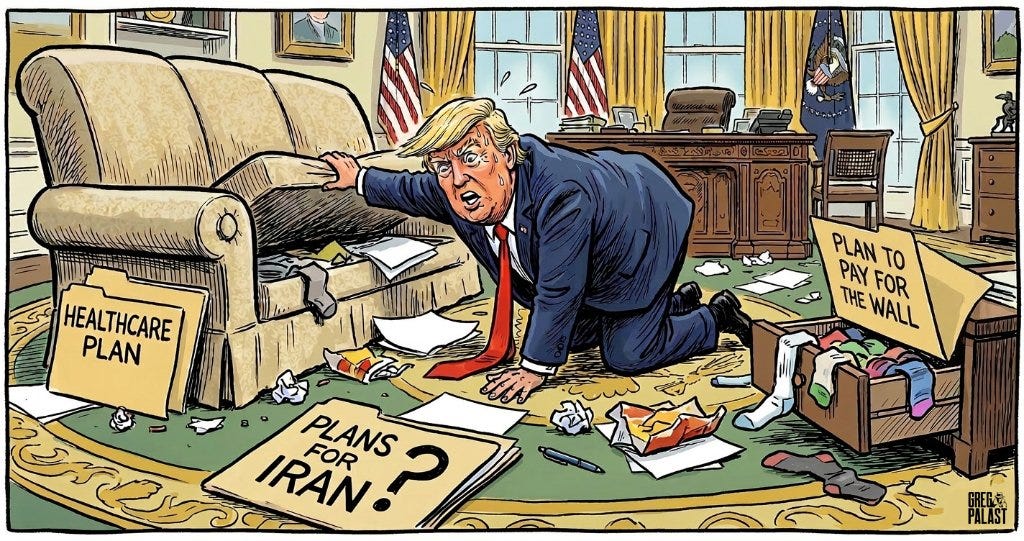
Trump knew how to get out of Vietnam; he can’t get out of Iran.
https://www.yahoo.com/news/articles/u-attacked-iran-show-power-151200758.html
The U.S.-Israeli war on Iran is already lost for the United States. Even if Iran is militarily defeated, it is unlikely the United States’ political objectives will be achieved. And, on balance, the United States will come out weakened from this war.
President Trump’s biggest problem lies in his attempt to square an impossible circle: imposing regime change in Iran without committing ground troops. Trump understands that neither his MAGA base nor the U.S. public has any appetite for another prolonged ground war in the Middle East. But regime change from the air does not work for a 90 million-strong country that is four times the size of Iraq and has been preparing for this eventuality for decades. The United States is beleaguered by the paradox of a leadership wanting to reimpose its global might through coercion and hard power and a population fundamentally opposed to any war that entails a significant expenditure of U.S. lives.
Why Iran Is Harder to Break Than It Looks
Despite all the talk of a downgraded Iran in the last two years, recent events have demonstrated the country’s capacity to resist. Iran’s resilience relies on a military and security architecture that is highly decentralized, with overlapping command structures between the regular armed forces and the Islamic Revolutionary Guard Corps. Recent days have shown how thoroughly Iran has developed extensive contingency planning designed to ensure continuity even under sustained attack. Airstrikes on Iran’s leadership have been ineffective — possibly even counterproductive, given their radicalizing effect on pro-government sectors of the population and their triggering of predetermined war protocols.
Equally important, Iran’s strategy is built around asymmetric warfare and escalation management. Its arsenal of weapons and proxy networks allow it to reap chaos across the region while imposing high costs on its adversaries. Iranian drones and missiles are relatively cheap to produce, but shooting them down requires interceptors that cost as much as 200 times more — and are limited in supply.
This leaves Trump facing a strategic trap. He must choose between the political cost of failing to achieve his regime change objectives and the political cost of walking back on his domestic promise of no more forever wars. The only viable exit strategy is to manufacture the appearance of victory: declaring that the objectives have been met even when they clearly have not.
The Peace Deal That Was Sabotaged the Day Before the Attack
Even if Trump manages to save face domestically, the war has already been lost at the international level — and the most damning evidence of that may be what happened the day before the bombs fell.
The first source of resentment is that the United States entered this war at Israel’s behest. Israel has been pushing for a decisive confrontation with Iran for years, against the repeated warnings of Washington’s other traditional partners in the Persian Gulf. Gulf states, organized in the Gulf Cooperation Council, opposed this war from the start — they understood that a major conflict with Iran would destabilize the entire region. They were not given prior notice of an attack meticulously planned with Israel. Prince Turki al-Faisal, Saudi Arabia’s former intelligence chief, was reflecting broadly felt regional sentiment when he told CNN: “This is Netanyahu’s war.”
This opposition led several states to support diplomatic efforts that were actively underway when the attack began. The day before the attack, Oman announced a breakthrough: Iran had agreed not to stockpile fissile material — a concession that went beyond anything Iran had agreed to in the 2015 JCPOA, which Trump had previously scuttled. “A peace deal is within our reach,” the Omani foreign minister said — before declaring the following day, once the strikes had begun: “I am dismayed. Active and serious negotiations have yet again been undermined.”
That agreement died on the runway. It is worth sitting with that fact.
How the War Is Fracturing U.S. Alliances in the Gulf
The Gulf states’ second grievance is that this war has seriously jeopardized their own security. As a result of the U.S.-Israeli attack, Iran retaliated against installations in Gulf states hosting U.S. military bases. In the Gulf, Iranian drones and missiles have struck targets in Bahrain, Kuwait, the United Arab Emirates, Oman, Saudi Arabia, and Qatar. There is rising anger in these countries that whereas the United States has done little to shield them from these strikes, it has done a great deal to protect Israel. This dynamic creates precisely the strategic outcome Iran has long sought: to erode the foundations of the U.S. security architecture in the Gulf. If trust between Washington and its Gulf partners weakens — potentially leading some states to eventually downgrade their security cooperation — that alone represents a significant strategic victory for Iran.
Bahrain did successfully lead a UN Security Council resolution condemning Iran for these strikes. But Gulf states’ hostility toward Iran is not the new development here. The new development is the regional resentment toward the United States — given that all parties knew Iran would likely attack its neighbors if Washington struck first.
The situation could deteriorate further if Washington, encouraged by Israel, chooses to double down on the total destruction of Iran rather than seek an exit strategy. Nobody in the region — except Israel — wants a prolonged war or the total collapse of the Iranian state. The specter of Libya’s failed state and Syria’s civil war still haunts the region. As a result, Iran’s neighbors mostly distrust the CIA’s renewed support for Kurdish militants, as well as growing talk of stoking Azeri, Baloch, and Arab nationalist movements.
Yet many of Trump’s domestic allies remain oblivious to these concerns. A good if baffling example of this deep-seated ignorance was Sen. Lindsey Graham’s recent threat to GCC states. “Get more involved as this fight is in their backyard… if not, consequences will follow” — captures the depth of that disconnect.
The Global Economic Fallout
Beyond the Middle East, this war now threatens the entire global economy. Oil prices have surged as a result of the selective closure of the Strait of Hormuz. In the United States, gas prices have risen sharply, fueling fear among Republicans that a continued energy crisis could hurt them in the midterm elections. In parts of Asia, the impact is being felt not only in rising fuel and liquefied gas prices but in supply constraints — several countries in South and Southeast Asia are already experiencing energy rationing, resulting in shortened work weeks, business closures, and partial school shutdowns.
Europe faces its own vulnerabilities. With the end of winter providing some relief, gas reserves nevertheless remain low. Russia has been quick to offer Europe an energy lifeline — which Europeans have so far rejected, determined to uphold their sanctions. Meanwhile, Washington first gave permission to India to purchase limited quantities of Russian oil, then removed sanctions on Russian oil altogether, albeit temporarily. Russia looks set to be among the war’s clearest beneficiaries.
China, highly dependent on Gulf oil imports, will also be forced to seek alternative energy sources — likely accelerating its reliance on Russian oil. But in the longer run, the war tilts the strategic balance decisively in Beijing’s favor. A protracted conflict consumes U.S. military resources globally, including in East Asia — the removal of the THAAD missile defense system from South Korea is an early example of that overreach.
The war will further erode Washington’s global prestige and deepen doubts among key allies about the reliability of U.S. leadership. China has spent years carefully nurturing its relations with Gulf states, including Saudi Arabia — and a net result of this war will be the consolidation of those ties. Some analysts have also argued that the energy shock could further accelerate a global transition toward renewables, raising global demand for Chinese solar panels, electric vehicles, and batteries. Against the backdrop of U.S. military adventurism, China’s reputation for diplomacy and economic stability will continue to gain global appeal.
The Nuclear Paradox
One of the great ironies of this war is that it marks the end of any significant deterrence of Iran — including on its nuclear program. If Iran survives the devastating destruction brought upon it, its appetite for a nuclear deterrent will have significantly increased. A likely consequence of this war, therefore, will be to accelerate the very threat it professed to avert.
Operation Epic Fury is increasingly looking like an epic fail. What began as an attempt to demonstrate the ongoing relevance of unrivaled U.S. military power is fast becoming one of the most consequential strategic miscalculations of this century — a pivotal moment in the steady erosion of U.S. hegemony.
Director of National Intelligence Tulsi Gabbard pointedly refused to say whether Iran presented an “imminent” nuclear threat to America before the U.S. launched its war, angering Democratic senators during an intelligence hearing on Wednesday.
“The only person who can determine what is and is not an imminent threat is the president,” Gabbard said during questioning from Sen. Jon Ossoff of Georgia.
The committee continued to press Gabbard over what the intelligence community concluded about Iran’s nuclear program before the war, given that a written version of her statement said Iran’s nuclear capabilities had been “obliterated” with “no efforts since” to rebuild after U.S. strikes last year.
“It is not the intelligence community’s responsibility to determine what is and is not an imminent threat,” Gabbard said. “That is up to the president, based on the volume of information that he receives.”
Gabbard’s statements inspired a sharp response from Ossoff, who cut in and said, “It is precisely your responsibility to determine what consists of a threat to the United States.” He accused Gabbard of “evading a question because to provide a candid response to the committee would contradict a statement from the White House.”
In a White House statement announcing the beginning of the Iran campaign, the Trump administration said the attack was necessary to “eliminate the imminent nuclear threat posed by the Iranian regime.”
Since then, however, officials have offered shifting explanations for the war, including comments from Secretary of State Marco Rubio that the U.S. attacked Iran because Israel was planning an attack on the country, a strike that was sure to provoke Iranian attacks in response on U.S. interests.
The back-and-forth in Congress comes amid larger scrutiny of the Iran war.
Joe Kent, the director of the National Counterterrorism Center, announced this week he was resigning, writing in an open letter that he could not “in good conscience support the ongoing war in Iran” because Iran posed “no imminent threat to our nation.”
During the Senate hearing, CIA Director John Ratcliffe challenged Kent’s conclusion.
“The intelligence reflects the contrary,” Ratcliffe said.
Joe Kent, the director of the National Counterterrorism Center, announced this week he was resigning, writing in an open letter that he could not keep supporting the war because Iran posed ‘no imminent threat to our nation’
He added that “any fair-minded assessment” would show Iran posed a threat to the U.S. and called the intelligence leading up to the war “flawless.”
Lawmakers also questioned Gabbard about what President Trump had been briefed about the potential of the war to trigger a shutdown of the vital Strait of Hormuz, which has since taken place.
Gabbard told the panel there had “long been an assessment of the IC [intelligence community] that Iran would likely hold the Strait of Hormuz as leverage,” but declined to discuss specific conversations with Trump.
Now that the war is ongoing, the Iranian regime appears to be “intact but largely degraded,” Gabbard said.
Outside of the Capitol, the administration was also on the defensive, with Vice President JD Vance telling an audience in Michigan the war-driven spike in gas prices will only be “temporary.”
Leading members of NATO have dismissed the Trump administration’s demands for assistance in reopening the Strait of Hormuz.
“It is not NATO’s war,” said a spokesperson for German chancellor Friedrich Merz this week. “NATO is an alliance to defend the alliance area. The United States did not consult us before this war, and so we believe this is not a matter for NATO or the German government.”