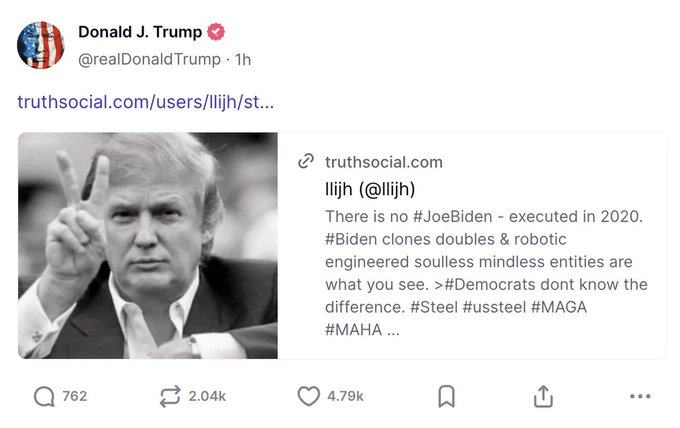
The United States is now facing the greatest threat to our free way of life in our history. Even the US Civil War was not the danger that is Donald Trump. In the Civil War, the South wanted to separate from the rest of the Union. Today, Trump does not want to separate from the US, he seeks to destroy the fundamental functions and purpose of the US. He seeks to destroy the Constitution, replacing the Judiciary and Legislative Branches with puppets of the Executive. Plainly stated, Trump seeks to establish himself as a dictator . . . and as of May 2025, he may succeed.
Because Daddy Trump and Daddy Musk are fighting, and he’s going to have to pick a side, and there are no good options—which perhaps is why the extremely online veep has gone very, very, very quiet.
Vance isn’t just the vice president, after all. He’s the vice president to a crazy, unhinged, vengeful sum’bitch who sent a murderous mob after his first vice president and relished their bloodlust.
Surely, at some point in Vance’s decision-making about whether to tether himself to Trump’s fortunes, he must have imagined, for at least half a second—even if he didn’t want to admit it—that perhaps one day an angry crowd could find its way to chanting “Hang JD!” just as easily as it once chanted “Hang Mike Pence!”
So, certainly it is best to side with Daddy Trump.
But on the other hand, Trump won’t be around forever. No matter how much he threatens it. And if Vance still dreams of calling himself president one day, he’s going to need some financial assistance. Perhaps the kind of tech bro billionaire money he’s been so actively courting all these years. And who has more of that money than Elon Musk?
Literally no one.
Meanwhile, Musk has made it perfectly clear in his too-online way what he thinks should happen.
No, the Republican-controlled House isn’t about to impeach Trump, and definitely no, the Republican-controlled Senate isn’t about to convict Trump, and absolutely no, Vance is not going to be replacing Trump now.
If Vance picks the right side now, maybe one day he’ll get his chance, with Musk’s katrillions of dollars helping him to get there. But which side is the right side?
If he wraps himself around Daddy Musk and incurs the wrath of Daddy Trump, will he get the chance to cash in three years from now?
Pity poor Vance, the guy who used to think Trump was Hitler until Trump offered him the super sweet job of being Pence’s replacement.
As the ugliest of ugly divorces rages on between his two masters, no wonder he’s keeping his mouth shut.
Okay, let’s admit, to be scrupulously fair he’s a former grocery clerk and gardener, not that there’s anything wrong with that:
When Thomas Fugate graduated from college last year with a degree in politics, he celebrated in a social media post about the exciting opportunities that lay beyond campus life in Texas. “Onward and upward!” he wrote, with an emoji of a rocket shooting into space.
His career blastoff came quickly. A year after graduation, the 22-year-old with no national security expertise is now a Department of Homeland Security official overseeing the government’s main hub for terrorism prevention, including an $18 million grant program intended to help communities combat violent extremism.
The White House appointed Fugate, a former Trump campaign worker who interned at the hard-right Heritage Foundation, to a Homeland Security role that was expanded to include the Center for Prevention Programs and Partnerships. Known as CP3, the office has led nationwide efforts to prevent hate-fueled attacks, school shootings and other forms of targeted violence.
Fugate’s appointment is the latest shock for an office that has been decimated since President Donald Trump returned to the White House and began remaking national security to give it a laser focus on immigration.
News of the appointment has trickled out in recent weeks, raising alarm among counterterrorism researchers and nonprofit groups funded by CP3. Several said they turned to LinkedIn for intel on Fugate — an unknown in their field — and were stunned to see a photo of “a college kid” with a flag pin on his lapel posing with a sharply arched eyebrow. No threat prevention experience is listed in his employment history.
Typically, people familiar with CP3 say, a candidate that green wouldn’t have gotten an interview for a junior position, much less be hired to run operations. According to LinkedIn, the bulk of Fugate’s leadership experience comes from having served as secretary general of a Model United Nations club.
“Maybe he’s a wunderkind. Maybe he’s Doogie Howser and has everything at 21 years old, or whatever he is, to lead the office. But that’s not likely the case,” said one counterterrorism researcher who has worked with CP3 officials for years. “It sounds like putting the intern in charge.”
“Totalitarianism in power invariably replaces all first-rate talents, regardless of their sympathies, with those crackpots and fools whose lack of intelligence and creativity is still the best guarantee of their loyalty.”
A campaigning Trump sold a booming economy, shrinking trade deficits, and job growth that would surpass anything the masses had ever seen. Then he was inaugurated. And his promise of plenty shattered on the rocks of reality. But the man knew his fans. He kept lying. And now that the numbers contradict his claims, he rages, obfuscates, and blames others.
On Wednesday, ADP, a preeminent payroll and HR services company released its May private sector employment report. It showed a sharp decline in new job growth, with only 37,000 new positions added. It was the smallest gain in more than two years. It was far short of Dow’s prediction of 110,000.
The future looks even worse. What will happen to jobs as Trump’s tariffs — the ones he hasn’t chickened out on — kick in? For instance, steel tariffs have doubled today to 50%. You can bet that any business making stuff out of the metal is calculating how many jobs it will have to shed as demand declines in the face of rising prices.
Sadly but predictably, the administration has no plan beyond yelling. On Thursday morning, Trump reacted to the dismal news by lashing out on Truth Social and finger-pointing. His target was the Fed head, Jerome Powell.
“ADP NUMBER OUT!!! “Too Late” Powell must now LOWER THE RATE. He is unbelievable!!! Europe has lowered NINE TIMES!”
As usual, the Bozo in the Oval was making stuff up. “Europe” — I’m guessing he means European Central Bank — has lowered its interbank loan rate three times, not “NINE TIMES!” in 2025. In addition, context is key. The EU did not do as well in 2024 (GDP +1.0%) as the US did in Biden’s last year (GDP +2.8%). Things were getting better in America.
The Fed was not worried about a recession. Their mandate was to stop inflation from returning. It wasn’t until Trump dynamited the economy that poor job growth became a pressing issue. In essence, Trump is saying, “I shat the bed. Why isn’t Powell cleaning it up?”
And shit the bed he did. America’s new golden trade age is on hold. The agricultural forecast, for one, is so bad that the administration is trying to bury the numbers. Here is how Politico reported it:
Trump administration officials delayed and redacted a government forecast because it predicts an increase in the nation’s trade deficit in farm goods later this year, according to two people familiar with the matter.
The numbers run counter to President Donald Trump’s messaging that his economic policies, including tariffs, will reduce US trade imbalances. The politically inconvenient data prompted administration officials to block publication of the written analysis normally attached to the report because they disliked what it said about the deficit.
Here is the relevant chart from the USDA’s report:
The trend was already negative. Trump is making it worse.
For years, the slam on Trump is that he is a man so bad at business he couldn’t even make money as a casino owner. The observation has legs because it perfectly sums up the man. It is a rare business that guarantees its operator a positive top-line cash flow. And yet Trump managed to squander that advantage.
I fear that the economic statistics will become so dire that the administration will start manipulating the numbers. Every previous President has let the Labor Department and other executive agencies issue their monthly, quarterly, and annual reports without political interference. That will not last, as the redacted trade report shows.
Conservatives and libertarians (who are merely conservatives too embarrassed to use the title) may hate the Fed, but it is a rara avis in today’s Washington — an independent agency. The citizens will have to rely on it and iprivate companies like ADP when MAGA starts cooking the government’s books.
In addition, should the Democrats regain the House in 2026 (and they had better do so, or it will get existential), at least part of one branch of the federal government will be on the people’s side. But if MAGA wins, we will have to live with a North Korean approach to information dissemination.
“You don’t have the cards right now. With us, you start having cards”
—Donald Trump to Volodymyr Zelenskyy, Oval Office, Feb. 2025
“I’m not playing cards. I’m very serious. I’m the president in a war.”
—Zelenskyy’s reply
In that frigid Oval Office exchange earlier this year, President Trump told Ukraine’s wartime president that he had no leverage. No cards. No power — unless the United States would continue to hand it to them.
What Idiot Child Trump didn’t realize was that Zelenskyy had already anticipated this move after the Biden administration left and was replaced by one hostile to Ukraine’s survival as a nation. While Trump saw a desperate leader begging for help, Zelenskyy was preparing to pivot to a redefinition of modern warfare if his largest ally would be abandoning them.
That pivot in silence is what became Operation Spiderweb.
And it wasn’t just a military operation. It was a message — to Russia, to the world, and perhaps most pointedly, to Trump: I don’t need your cards. I’ve built my own deck
The Zelenskyy Doctrine
President Zelenskyy’s doctrine is not just military—it’s cultural. It’s the war of a nation that has had to prove its right to exist over and over again. These are people that will continue to fight and survive whether Trump continues support or not. And now, it’s showing other small or threatened countries — Taiwan, Estonia, Georgia — what survival might look like in the 21st century.
Cards on the Table
President Zelenskyy may not be the leader history or Ukraine expected — but he may be the one they needed.In the span of a few years, Zelenskyy has gone from underestimated to indispensable, from a political novice to a battlefield innovator. Not because he sought power, but because he refused to let go of his country.
And when he was told by Trump that he “had no cards,” Zelenskyy didn’t flinch.
He built a new deck — and played it to perfection.
Even as government agents from the Department of Homeland Security (DHS) ramp up their arrests and confrontations, the lug nuts on the wheels of the White House bus continue to loosen.
On Wednesday, officers from the Federal Protective Service, which is part of DHS, handcuffed an aide in the Manhattan office of Representative Jerry Nadler (D-NY). Someone sitting in the office captured the confrontation on video.
Federal agents are trying to meet the quotas the administration has set for arrests by detaining individuals outside immigration courtrooms after they show up for their scheduled hearings. According to Christopher Maag of the New York Times, peaceful protestors gathered on Wednesday outside the Manhattan federal building that holds an immigration court and immigration advocates gathered outside the courtroom. As officers detained immigrants outside the courtroom, advocates reminded the immigrants they had a right to remain silent. Officers threatened to arrest the advocates for loitering, and a member of Nadler’s staff invited some of the advocates to Nadler’s office a floor above the court to defuse the situation.
It’s one of the greatest preventable mass deaths in modern history: around two people every minute of every day, day and night, week after week, soon to be year after year.
In the time it takes you to read this article, several dozen children will have died because of actions taken — with full knowledge of this consequence — by South African immigrant Elon Musk, Big Balls and his teenage buddies, Donald Trump, and Marco Rubio.
Children who wanted to live as desperately as do yours and mine, whose parents grieve them every bit as much as we would grieve the death of our own kids, are dying as you read these words.
Even worse, Musk and Rubio keep lying about the blood on their hands. Nobody knows if Rubio is drinking himself to sleep to deal with the guilt, but according to The New York Times Musk is taking mind-numbing drugs at a level that would make Charles Manson blush.
“I would like to speak briefly and simply about a serious national condition,” Senator Margaret Chase Smith of Maine told her colleagues on June 1, 1950. “It is a national feeling of fear and frustration that could result in national suicide and the end of everything that we Americans hold dear…. I speak as a Republican, I speak as a woman. I speak as a United States senator. I speak as an American.”
“Those of us who shout the loudest about Americanism in making character assassinations are all too frequently those who, by our own words and acts, ignore some of the basic principles of Americanism,” she pointed out. Americans have the right to criticize, to hold unpopular beliefs, to protest, and to think for themselves. But attacks that cost people their reputations and jobs were stifling these basic American principles, and the ones making those attacks were in her own party.
Wisconsin senator Joe McCarthy, who was sitting two rows behind her, led a faction that had cowed almost all of the Republican Party into silence by accusing their opponents of “communism.” Smith recognized the damage McCarthy and his ilk were doing to the nation. She had seen the effects of his behavior up close in Maine, where the faction of the Republican Party that supported McCarthy had supported the state’s Ku Klux Klan.
“Freedom of speech is not what it used to be in America,” Senator Smith said. “It has been so abused by some that it is not exercised by others.”
Senator Smith wanted a Republican administration, she explained, but to replace President Harry Truman’s Democratic administration—for which she had plenty of harsh words—with a Republican regime “that lacks political integrity or intellectual honesty would prove equally disastrous to this nation.”
“I do not want to see the Republican party ride to political victory on the Four Horsemen of Calumny—Fear, Ignorance, Bigotry, and Smear.”