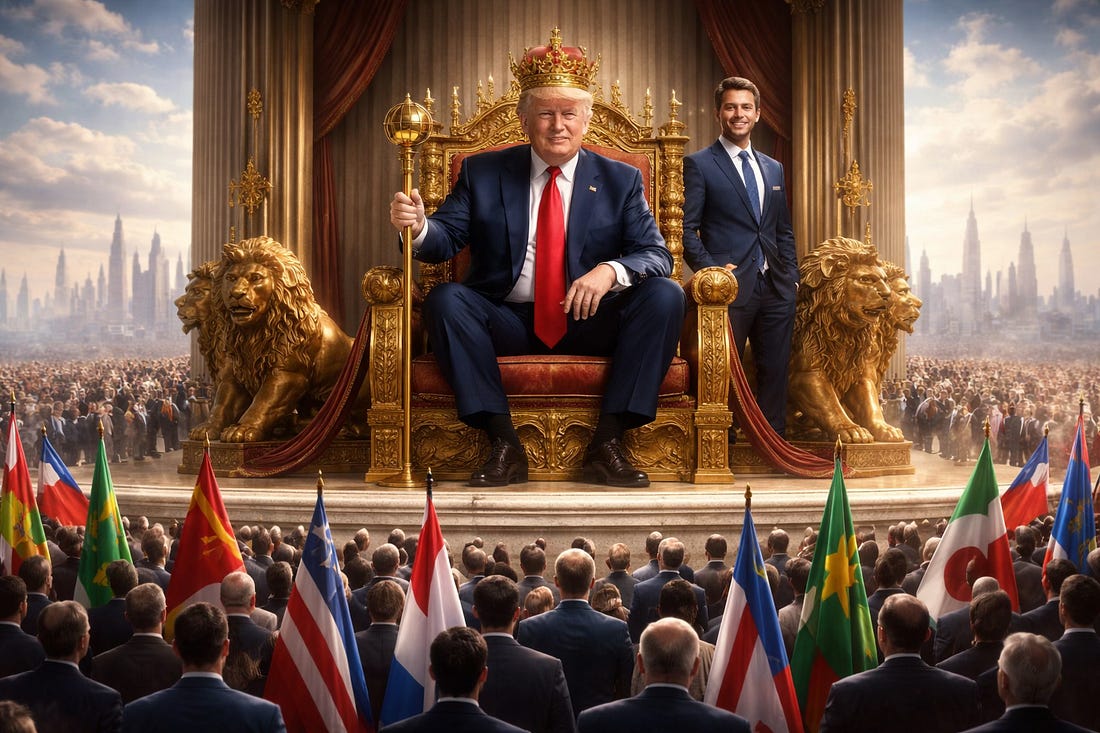
The United States is now facing the greatest threat to our free way of life in our history. Even the US Civil War was not the danger that is Donald Trump. In the Civil War, the South wanted to separate from the rest of the Union. Today, Trump does not want to separate from the US, he seeks to destroy the fundamental functions and purpose of the US. He seeks to destroy the Constitution, replacing the Judiciary and Legislative Branches with puppets of the Executive. Plainly stated, Trump seeks to establish himself as a dictator . . . and as of May 2025, he may succeed.
President Donald Trump has spent nearly a quarter of his second term at a golf club, according to a tracking website. The 79-year-old has visited golf clubs at least 79 times since taking office on January 20, 2025, or about 22.8 percent of the presidency, according to DidTrumpGolfToday.com.
The tracker, which compiles data based on Trump’s public schedule, does not include data from December 2025.
Since returning to office, Trump’s golf club visits have cost taxpayers an estimated $110,600,000,according to the website.
The tracker based that calculation on a 2019 Government Accountability Office report on the cost of four golf trips during Trump’s first presidency. Trump’s busiest month at the golf club was August, when he spent every weekend at his golf clubs, totaling 10 days. The president also spent nine days at the golf club in both March and November, according to the tracker.
I recall back in the heyday of the Tea Parties in Virginia “Agenda 2021” was one of their big things. While most local Tea Parties disappeared from Virginia after Obama’s last term, their remnants picked up the “COVID vaccine will kill you” chant and added it to “Agenda 2021,” “chemtrails,” and other rightwing fever dreams. WTF is wrong with these people?
President Donald Trump said Wednesday that he expects construction of the “Triumphal Arch” he wants to build in Washington, D.C. to begin “sometime in the next two months.”
The arch is one of several building projects Trump has pushed for as the country enters into its 250th year, proposed to be constructed at the culmination of a bridge that leads from the Lincoln Memorial to Arlington National Cemetery. The design of models Trump has shown reporters echoes that of the Arc de Triomphe in Paris, France and would be designed to honor America’s military veterans.
The president’s other efforts to remake Washington, D.C. have been divisive, from the demolition of the White House’s East Wing for a ballroom to the addition of his name to the Kennedy Center, cheered by his supporters and drawing condemnation — and lawsuits — from critics.
One day Trump’s attempt to establish a dictatorship in the US — supported by about 40 percent of the population – will be over and the rest of us will have to restore our democratic republic.
The question then will be how to deal with Trump’s followers. The example of Nazi Germany after WW II may be instructive.
“Historians have a word for Germans who joined the Nazi party, not because they hated Jews, but out of a hope for restored patriotism, or a sense of economic anxiety, or a hope to preserve their religious values, or dislike of their opponents, or raw political opportunism, or convenience, or ignorance, or greed.
That word is “Nazi.” Nobody cares about their motives anymore.
They joined what they joined. They lent their support and their moral approval. And, in so doing, they bound themselves to everything that came after. Who cares any more what particular knot they used in the binding?”
― A.R. Moxon
When Trump and his dictatorship are gone, and we are faced with dealing with his supporters, remember this:
Now that Trump is one year into his second term, it is clear that Trump is not the problem. The problem — the threat to our democracy — has been 50 years in the making and that threat is the Republican Party.
I have added a new section to my Clear and Present Danger blog: THE PEOPLE WHO ARE KILLING OUR DEMOCRACY.
This new section will feature articles, background, and facts about the individuals who are the real threat to our democracy.
The first person I will focus on is Chief Justice John Roberts whose life’s work has been to destroy the Voting Rights Act of 1965 and the firmly establish the rule of wealthy white people.
In 2013, when Chief Justice John Roberts Jr. issued the most far-reaching Supreme Court decision on voting rights in the 21st century, he finally succeeded in gutting a civil rights law he has been fighting his entire career. For three decades, Roberts has argued that the United States has become colorblind to the point where aggressive federal intervention on behalf of voters of color is no longer necessary—and this case, Shelby County v. Holder, was the pinnacle of that crusade.
Roberts honed his views on race and voting as a clerk for Justice William Rehnquist, a man who as a court clerk himself had written a memo endorsing Plessy v. Ferguson, the “separate but equal” doctrine upholding segregated schools. On the high court, Rehnquist helped redefine opposition to civil rights laws as a commitment to color blindness, and he used this theory to undermine the 1965 Voting Rights Act.
Roberts took a similar outlook in the Reagan Justice Department, where he worked after finishing his Rehnquist clerkship. Gerry Hebert, now executive director of the Campaign Legal Center, was also at the DOJ. He recalls that Roberts “had it in for the Voting Rights Act,” which Roberts thought should cover only intentional discrimination, not discriminatory results or effects of state voting regulations. But proving intentional discrimination is virtually impossible—and besides, Hebert says, judges “don’t want to find that somebody was a racist.” They’d rather focus on the discriminatory impact of a law. “I don’t think John Roberts ever got that.”
My new blog section will be a work in progress; I’ll add to it as time goes on. Bookmark it and come back often.
The House Judiciary Committee on New Year’s Eve released a transcript and video of its closed-door hearing with Jack Smith, the former special counsel who led the two failed prosecutions of President Donald Trump.
The deposition conducted earlier this month lasted more than eight hours, during which Smith was grilled by lawmakers over the twin criminal investigations into Trump – one probing the mishandling and retention of classified documents and a second inquiry into his role in attempting to overturn the 2020 election.
“The decision to bring charges against President Trump was mine, but the basis for nine of those charges rests entirely with President Trump and his actions, as alleged in the 10 indictments returned by grand juries in two different districts,” Smith told the committee.
Republican lawmakers have lambasted the investigations as alleged “weaponization” of the justice system against the president and his allies, particularly criticizing Smith for subpoenaing the phone records of lawmakers who spoke with Trump about the election scheme.
This video is 8 hours long; Jack Smith’s testimony.
Here is a link to the transcript of Smith’s 8-hour testimony.
Giving testimony was a significant risk for Smith as Trump has called for him to be prosecuted.
Here are the highlights of Smith’s testimony:
Toll records were ‘very important’
The GOP-led committee grilled Smith on his office’s move to obtain toll records from members of Congress, meaning phone records showing whom lawmakers had called and the time of the calls. Toll records do not provide the content of phone calls.
Smith said that evidence was “very important” for showing Trump’s alleged criminal intent in the election subversion case.
“Having a record that is a hard record about a time, and the timeline of that afternoon was particularly important because the violence had started. The president refused to stop it,” Smith said.
“He endangered the life of his vice president, and then he’s getting calls, and not just – not calls from Democrats, not calls from people he doesn’t know – calls from people he trusts, calls from people he relies on – and still refuses to come to the aid of the people at the Capitol,” he added.
Asked about calls from lawmakers for “accountability” because their phone records were obtained, Smith said Trump was ultimately responsible for their records being subpoenaed.
“These records are people, in the case of the senators, Donald Trump directed his co-conspirators to call these people to further delay the proceedings. He chose to do that.”
‘Grave risk of obstruction of justice’
Smith also faced sharp questions about whether his pursuit of lawmakers’ toll records violated the Constitution’s Speech or Debate Clause, which shields legislators from certain law enforcement actions related to their legislative duties.
Smith said his team consulted with Justice Department experts and that he was not aware of court precedents that would have prohibited those subpoenas. He also defended the move by his office to obtain orders from court that prevented phone companies from disclosing to the lawmakers that their records had been turned over to investigators.
“There was a grave risk of obstruction of justice, given the obstructive conduct of President Trump as is set forth, for example, in the indictment in Florida,” Smith said, referring to the classified documents case.
Smith also said he did not regret his decision to repeatedly seek gag orders against Trump, as he attempted to limit the president’s public statements that he argued would influence the cases and endanger people involved, including FBI agents.
The prosecutors’ requests for non-disclosure orders did not tell the judges that the records being sought were for lawmakers’ phones, which was in line with DOJ policy at the time, Smith said.
Since then, the department has changed its guidance, according to Smith’s testimony, and prosecutors must inform courts if the non-disclosure orders pertain to the phone records of members of Congress.
Smith defends against political bias claims
Smith testified that he never spoke to Joe Biden about the investigations, nor did he ever receive instructions from the former president about his work.
He also repeatedly said that he would have approached the cases the same if he had been asked to investigate a Democratic president – such as Biden or Barack Obama.
Asked if he lobbied or petitioned for the special counsel position, Smith said he did not and accepted the role only because he believed “I thought I was the right person for the job. I knew that this would be a challenging job.”
Weighing charges against co-conspirators
Smith testified that he was still weighing whether to bring charges against Trump’s alleged co-conspirators in the election subversion case when Trump’s reelection forced his investigation to come to an end.
But Smith said that he would have “welcomed” those alleged co-conspirators, such as Trump attorney John Eastman, to the stand if the case had gone to trial and if Trump’s defense team sought to call them.
Among the Trump associates who sat for interviews with Smith’s team were Boris Epshteyn and attorney Rudy Giuliani, Smith testified.
Asked why he did not follow a common prosecutorial approach of charging lower level accomplices before pursuing the higher levels of a conspiracy, Smith said that he did not need to follow that path to secure witnesses against Trump.
“This was not a case where we needed more witnesses,” Smith testified. “It was a case where we needed to be able to present the case in a streamlined way because there was so much evidence.
Unreleased section of report on Mar-a-Lago documents
Smith was careful to avoid divulging any information that was not already public about Trump’s handling of classified documents in Mar-a-Lago, repeatedly stating that he was barred by a court order from testifying about the contents of the second volume of his report.
Before shutting its doors, Smith’s team compiled a 137-page final report on the probe before Trump was sworn into office for a second term. But the judge who presided over the classified documents case, Aileen Cannon, has prohibited releasing the section on the classified documents case.
The Justice Department told Smith’s legal team that it believed Cannon’s order applied to Smith, his attorney said, which “significantly” limited what he could say publicly.
Giuliani said that he did not believe his own claims about voter fraud
Smith told the committee that Guiliani, who was one of the uncharged co-conspirators in the election interference case, did not believe his own claims he spread about voter fraud in the 2020 presidential election.
“In fact, when we interviewed him, he disavowed a number of the claims,” Smith said. “He claimed they were mistakes or hyperbole, even the claim about Ruby Freeman, where he, you know, basically destroyed this poor woman’s life by claiming she was a vote scammer.”
Giuliani last year reached an agreement with two Georgia election workers – Freeman and Shaye Moss – that he defamed to settle the nearly $150 million judgment against him, in a deal that allowed him to keep his home and most valuable possessions.
Smith got emotional discussing fired FBI agents and prosecutors
Smith was emotional when he discussed prosecutors or FBI agents who have been fired by the Justice Department for their work on cases related to the January 6, 2021, US Capitol riot.
“I think what has happened to career prosecutors and career FBI agents is awful. It’s contrary to the rule of law,” Smith said. “It’s contrary to who I think we are as a country.”
Smith apologized for getting emotional when discussing one agent in particular who worked on his case. He was “fired for doing his job,” two weeks after the passing of his wife.
“These are not partisans,” Smith added. “They’re people who have decided they don’t want to make a lot of money. They’re not looking for fame. They just want to do good work, and I think when you lose that culture, you lose a lot.”
Seeking a public hearing
Smith also stressed that he was still willing to testify in a public setting – a request that was denied by the committee chairman in favor of the closed-door meeting. He told lawmakers that he was willing to appear voluntarily to defend his team’s work, arguing that many of them had been “vilified” for their work.
“They’re not people who like to go in front of cameras and defend themselves,” Smith said. “There have been mischaracterizations about my work.”
Asked if he was still willing to appear voluntarily for a public hearing, Smith replied: “Yes.”
Today is December 29. Here in Virginia, in 19 days, we will — thank God — swear in Democrat Abigal Spanberger as governor, ending the reign-of-error by current Gov. Glenn Youngkin.
Virginia’s Glenn Youngkin sparked presidential buzz four years ago when he upset former Democratic Gov. Terry McAuliffe.
Youngkin spent his first year in office running around the country campaigning for pro-Trump candidates in fifteen states, visiting many of the states 2-3 times. Every single on of these candidates lost — that’s right, they all lost.
In addition to being a proven loser in campaigning, Youngkin’s star faded as he hemmed and hawed about running for president for most of his term, and as he failed to turn Virginia’s legislature red. Meanwhile, Trump lost the state last November and his lieutenant governor lost the race to succeed him this November.
Youngkin is now spending his final month in office squabbling with Gov.-elect Abigail Spanberger over the state’s universities. Democrats won court decisions that effectively prevented Youngkin from filling 22 board positions at three higher institutions, including five at the University of Virginia, before Spanberger is sworn in. But at Youngkin’s urging and over Spanberger’s objection, the University of Virginia board named a new president before those vacancies are filled. One last stick-in-the-eye to Democrats may give Youngkin a fresh round of accolades from conservatives, but that’s well short of what he needs to join the top tier of Republican hopefuls in 2028.
Meanwhile, a couple of weeks ago there were rumors that Youngkin was being considered by Trump for a Cabinet position as Trump moves to get rid of some of the losers he appointed at the start of his second term. Whatever.
Nothing will happen to make Youngkin a presidential candidate — or a VP candidate for that matter. He should take the $40 million the Carlyle Group gave him to go away and enjoy retirement.
Pictured, JD Vance (left) and American Oligarch Peter Thiel. Jeff Swensen/Getty Images; Marco Bello/Getty Images
The GOP has spent 50 years building a machine to end democracy, funded by oligarchs who will outlive any single president. They want us to believe this ends with one man. It doesn’t. We don’t need false comfort right now, we need real clarity. That means acknowledging that as long as the seditious and openly criminal Republican Party exists, we are fighting the same machine that built him, protected him, and will replace him the moment he’s gone. We have spent ten years personalizing a systemic crisis around a single figure. That personalization is itself a form of control. It lets us imagine that removing him solves the problem. It lets us fantasize about accountability and a soft landing. It lets us wait for rescue instead of doing the work.
Robert Reich recently argued that Trump’s end is imminent. The MAGA base is falling apart, he wrote. Congressional Republicans are finding their backbones. The ground is finally shifting.
I respect Robert. He’s been a consistent voice on the proper side of this fight for decades. So let’s take his argument seriously. Let’s look at the evidence he’s citing and ask what it actually tells us.
The polling decline is real. Trump’s approval has hit 36% in Gallup tracking, his second-term low. A CNN poll found 61% of Americans say his policies have worsened economic conditions. These numbers are bad.
But context matters. Trump’s all-time low was 34%, right after January 6. His first-term average was 41%. He never once reached 50% approval in his entire first presidency. The mid-30s is not a collapse. It is his floor, and the floor is holding.
But context matters. The Republican Party’s project is not to be popular or win elections. It is to make elections unnecessary for holding power. Gerrymandered maps, voter suppression, a captured judiciary, and the procedural stranglehold of the Senate filibuster all serve the same function: insulating Republican rule from democratic accountability. Trump’s approval among the broader public matters only if that public can translate disapproval into political consequences. The party has spent decades building the infrastructure of preventing democratic functioning.
The November 2025 elections were a Democratic sweep. Spanberger won Virginia’s governorship by 15 points. Sherrill carried New Jersey by 13. Mamdani became New York City’s first Muslim mayor. Exit polls showed 55-69% disapproval of Trump across every major race. These results are significant.
But this is swing voters responding to chaos. This is the suburbs recoiling. This is not the MAGA base defecting. The coalition that carried Trump to victory in 2024 has not abandoned him. Voters at the margins have. That matters electorally. It does not mean the movement is collapsing.
Reich points to Republican fractures. Some are grumbling about the budget. Some reject the tariff dividend proposal. Some want to extend ACA subsidies. Hawks dislike the Putin courtship.
But grumbling is not governing. When it came time to vote on the Big Beautiful Bill, two Republicans out of 273 voted no. That is a 1% defection rate. The tariff dividend was never even brought to a vote. The ACA subsidy debate remains unresolved because leadership won’t allow a floor vote. The fractures are nonexistent in practice. The grumbling itself is the performance, a way to maintain the fiction that Republicans aren’t voting in lockstep while they vote in lockstep.
And then there is Marjorie Taylor Greene. After Romney. After Cheney. After Kinzinger. After the party systematically destroyed every Republican who broke ranks. After years of enforcing total loyalty, his most devoted defender finally walked away. One more name on a short list that keeps getting shorter as the party purges dissent.
She was his most loyal defender. She voted with him 98% of the time. She spent millions on his campaigns. She flew from her father’s brain surgery to vote against his second impeachment. And when she broke with him over the Epstein files, he called her a traitor within days. She also announced her resignation timed to within a few days of her congressional pension beginning.
This is not a crack in the foundation. This is the foundation demonstrating how solid it is. The apparatus that destroyed Liz Cheney and Adam Kinzinger and Mitt Romney’s political future did exactly what it was designed to do: enforce total loyalty and obliterate dissent.
So let’s say Reich is right about all of it. Let’s say the polling collapse accelerates. Let’s say Republicans lose the House in 2026. Let’s say Trump’s health fails, his mind deteriorates further, or he simply dies. He is 79 years old. It could happen tomorrow.
Here is what does not change:
The 43 Republican senators who acquitted him after he incited an insurrection remain in office or have been replaced by others who would have done the same. The Supreme Court that ruled him above the law serves for life. The federal judiciary packed with Federalist Society judges will shape American law for decades. The 47% of Project 2025 already implemented does not reverse itself. The 200,000 federal workers fired or forced out do not return to their jobs. The gutted agencies do not rebuild overnight. The dismantled regulations do not reassemble themselves.
The Varieties of Democracy Institute, the world’s leading authority on measuring democratic health, identified the United States as undergoing the fastest episode of changing into a dictatorship in modern American history. Director Staffan Lindberg stated in March that if the current trajectory continues, the United States will no longer qualify as a democracy when they assess 2025. That trajectory is not about one man. That trajectory is about captured institutions and a party apparatus committed to single-party rule.
We tried the institutional remedies. We impeached him twice. The Senate acquitted him twice. A jury convicted him of 34 felonies. No judge sentenced him. The Supreme Court granted him immunity. We voted him out in 2020. He came back and won by a wider margin.
Four years of Biden changed nothing structurally. The courts remained captured. The gerrymandered maps remained intact. He was able to make marginal progress that was obstructed at every turn, overturned by SCOTUS, or immediately undone by Trump. The filibuster remained in place, allowing Republicans to block voting rights legislation with unified opposition. We followed the rules. They ran out the clock. And at the end of it, we got a second Trump term that has done more damage in ten months than his entire first four years.
Trump did not build this. The Heritage Foundation wrote Project 2025. The Federalist Society built the judicial pipeline. The Republican National Committee enforces party discipline. The conservative media ecosystem manufactures consent. State legislatures draw maps that let them choose their voters. Dark money networks fund the whole operation.
Trump is only a convenient fool. He normalized what was previously unthinkable. He proved what was possible. He moved the ball further down the field than anyone before him. But he is still an instrument. When he is gone, everything he proved remains proven. Every precedent he set remains set. Every norm he shattered remains shattered.
The Republican Party has been building toward this for 50 years. The Powell Memo. The Heritage Foundation. The Federalist Society. Gingrich burning down congressional norms. The Southern Strategy. Gerrymandering. Voter suppression. McConnell holding a Supreme Court seat hostage for a year.
Trump did not break the system. He is the product of a party that spent half a century crafting the tools to end American democracy.
As long as the Republican Party exists, our democracy remains under threat. That was true before Trump and will remain true after him. The party must be dismantled. Not defeated in one election. Not moderated. Dismantled and its leaders incarcerated for sedition and corruption.
So when the headlines tell you the ground is shifting, maybe something is happening. When pundits tell you the MAGA base is cracking, maybe the margins are eroding. When Trump eventually leaves the stage, it will feel like relief. We will want to exhale. We will want to believe the worst is over.
Do not exhale.
The day after Trump is gone, we have the exact same work to do. The same captured courts. The same gerrymandered maps. The same consolidated media. The same oligarch class. The same party apparatus that protected him through everything and will find another vehicle for their project before his body is cold.
And the next vehicle will be less repugnant. Someone who passes the same fascist laws and strips away the same freedoms but with less spectacle, someone who makes it all look more professional, and then people stop paying attention. Trump’s repulsiveness keeps people in the streets. But the Republicans are the ones passing the policies anyway. They’re the ones telling him what to support. A polished version pushing the exact same agenda without the daily outrages will be far more dangerous. The next one gets a grace period while the world celebrates, and the fascism continues while everyone exhales.
He covered a lot of ground for them. That doesn’t all reverse with him gone. The project does not end with him, and if we act like it does, we hand Republicans a free pass for everything they built while we were staring at one man.
We have spent ten years personalizing a systemic crisis around a single figure. That personalization is itself a form of control. It lets us imagine that removing him solves something. It lets us fantasize about accountability that will never come through the institutions they have captured. It lets us wait for rescue instead of doing the work.
Stop waiting for Trump to die. The fight is the same either way.
So what actually works? Three things.
First, states must investigate, prosecute, and criminally indict corrupt politicians at every level and refuse to hand those cases up to federal jurisdiction. If we don’t hold these people accountable ourselves, no one will. This should be done through an interstate anti-corruption compact where states work together to rid our federal government of criminal actors.
Second, states must build social safety nets at the state and multi-state level that actually improve residents’ lives, because the federal government has been captured and isn’t coming to help.
Third, multi-state non-compliance with bullshit SCOTUS and federal decisions.
That’s it. That’s what needs to happen. It takes political will, and it takes us demanding it from every state official we can reach.
NO American greeted Zelenskyy when he arrived in Miami last night.
When Putin came to America he got a red carpet, a joyous Presidential greeting, and a bestie’s ride in Trump’s armored limo.
Before the meeting with Zelenskyy Trump spoke to Putin for two hours (!!!!!!!!), and described his conversation with the mass murderer of Moscow as “good” (no condemnation for Putin’s starting of the war, the brutal assault on Kyiv yesterday, or the continued attacks on civilian targets. ):
Stephen Miller and Jared Kushner were at the negotiating table today. No experts on Russia or Ukraine on our side of the table.
Trump and Zelensky had a press conference where both sides committed to keep working. Throughout the run up and the event today Trump and his team continued to repeat outlandish Russian talking points….
Listen to Trump here. The man negotiating the fate of the West is clearly unwell and delusional. Trump: “It’s funny, I settled 8 wars. Some were going on for 35 years. And we got them settled in a couple of days. Some of them — one was going on for 37 years. I settled it in one day. But this is a very complex one” (Via Aaron Rupar)
Listen again to Trump here. This fool who is negotiating the fate of the West is clearly unwell and delusional. Catch Zelenskyy’s facial expressions when Trump claims Putin wants Ukraine to succeed and is willing to help with reconstruction:
Here’s that question again with a close up on Zelenskyy:
As expected it was a farce as Trump continues to help Putin to continue killing Ukrainians and threatening the rest of Europe.