The U.S. has a drug problem and sinking random speeding boats is not the answer

The United States has a drug problem. Provisional data (as of May 14, 2025) from the CDC’s National Center for Health Statistics indicate there were an estimated 80,391 drug overdose deaths in the United States during 2024—a decrease of 26.9% from the 110,037 deaths estimated in 2023. That’s more deaths than from kidney disease and less than from diabetes. Opioid use disorder affects 2.1 million people in the US, statistic as of 2024.

Donald Trump and Pete Hegseth have decided that the most effective way to deal with this problem is to kill people with small boats off South America, which may be trafficking narcotics. They accuse the people they are killing of “poisoning” Americans.

The standard treatments for opioid use disorder involve social and psychological interventions, along with supportive medication to lessen the effects of the opioids. The Trump administration has cut money for such treatments.

The accusation of “poisoning” and the claims for the numbers of American lives saved with each boat destroyed make sense only if a network of attackers are forcibly injecting Americans with the drugs. Those Americans use the drugs themselves as a result of psychological and physical disabilities.  The numbers are absurd – 25,000 lives per boat out of a total of 80,000 deaths last year.

If the boats being destroyed are carrying drugs, which the administration has asserted but not shown to be the case, they may not be headed for the United States, but other points in the Caribbean and Central America. Major drug trafficking routes to the US come in other directions.

The administration also claims that the sales of these drugs support the control of cities by drug cartels, another assertion not proved. While there may be skirmishes between gangs, none are in control of any cities.

The Coast Guard has been interdicting drug runners for decades. They stop the boats, confiscate the cargoes, and turn the people over to law enforcement.

There is no reason to use the military for this civil problem. We all know this, but I thought it was worth spelling out.


In Trump 1.0, professionals were sometimes able to curtail the worst impulses of Trump and his closest cronies. In Trump 2.0, these people get pushed out:

Defense Secretary Pete Hegseth shocked official Washington in mid-October when he announced that the four-star head of U.S. military operations in the Caribbean was retiring less than a year into his tenure.

But according to two Pentagon officials, Hegseth asked Adm. Alvin Holsey to step down, a de facto ouster that was the culmination of months of discord between Hegseth and the officer. It began days after President Trump’s inauguration in January and intensified months later when Holsey had initial concerns about the legality of lethal strikes on alleged drug boats in the Caribbean, according to former officials aware of the discussions.

Not long after, Hegseth announced that Holsey would be retiring.

Hegseth’s move, which hasn’t been previously reported, sheds new light on a brewing controversy over the legality of the military’s campaign in the Caribbean, and raises questions over whether servicemembers with concerns about the attacks are being listened to.

While Hegseth has dismissed a number of high-ranking military leaders since taking over the Pentagon, the ouster of a commander during an unfolding military operation was an extraordinary move, lawmakers and experts note.

“Having [Holsey] leave at this particular moment, at the height of what the Pentagon considers to be the central action in our hemisphere, is just shocking,” says Todd Robinson, who served as assistant secretary for international narcotics and law enforcement affairs until January.

Remember that Hegseth’s support of war criminals was the main reason Trump selected him in the first place.

Trump administration: “A sickening moral slum . . . “

A sickening moral slum of an administration

George Will;  Washington Post, Dec 2

 Regarding Venezuela, Ukraine and much more, Trump and his acolytes are worse than simply incompetent.

Defense Secretary Pete Hegseth seems to be a war criminal. Without a war. An interesting achievement.

In 1967, novelist Gwyn Griffin published a World War II novel, “An Operational Necessity,” that 58 years later is again pertinent. According to the laws of war, survivors of a sunken ship cannot be attacked. But a German submarine captain, after sinking a French ship, orders the machine-gunning of the ship’s crew, lest their survival endanger his men by revealing where his boat is operating. In the book’s dramatic climax, a postwar tribunal examines the German commander’s moral calculus.

No operational necessity justified Hegseth’s de facto order to kill two survivors clinging to the wreckage of one of the supposed drug boats obliterated by U.S. forces near Venezuela. His order was reported by The Post from two sources (“The order was to kill everybody,” one said) and has not been explicitly denied by Hegseth. President Donald Trump says Hegseth told him that he (Hegseth) “said he did not say that.” If Trump is telling the truth about Hegseth, and Hegseth is telling the truth to Trump, it is strange that (per the Post report) the commander of the boat-destroying operation said he ordered the attack on the survivors to comply with Hegseth’s order.

Forty-four days after the survivors were killed, the four-star admiral who headed the U.S. Southern Command announced he would be leaving that position just a year into what is usually a three-year stint. He did not say why. Inferences are, however, permitted.

The killing of the survivors by this moral slum of an administration should nauseate Americans. A nation incapable of shame is dangerous, not least to itself. As the recent “peace plan” for Ukraine demonstrated.

Marco Rubio, who is secretary of state and Trump’s national security adviser, seemed to be neither when the president released his 28-point plan for Ukraine’s dismemberment. The plan was cobbled together by Trump administration and Russian officials, with no Ukrainians participating. It reads like a wish-list letter from Vladimir Putin to Santa Claus: Ukraine to cede land that Russia has failed to capture in almost four years of aggression; Russia to have a veto over NATO’s composition, peacekeeping forces in Ukraine and the size of Ukraine’s armed forces. And more.

Rubio, whose well-known versatility of convictions is perhaps not infinite, told some of his alarmed former Senate colleagues that the plan was just an opening gambit from Russia — although Trump demanded that Ukraine accept it within days. South Dakota Republican Sen. Mike Rounds, a precise and measured speaker, reported that, in a conference call with a bipartisan group of senators, Rubio said the plan was a Russian proposal: “He made it very clear to us that we are the recipients of a proposal that was delivered to one of our representatives. It is not our recommendation. It is not our peace plan.” Hours later, however, Rubio reversed himself, saying on social media that the United States “authored” the plan.

The administration’s floundering might reflect more than its characteristic incompetence. In a darkening world, systemic weaknesses of prosperous democracies are becoming clearer.

Harvard sociologist Daniel Bell’s 1976 book, “The Cultural Contradictions of Capitalism,” argued that capitalism’s success undermines capitalism’s moral and behavioral prerequisites. Affluence produces a culture of present-mindedness and laxity; this undermines thrift, industriousness, discipline and the deferral of gratification.

Today’s cultural contradictions of democracy are: Majorities vote themselves government benefits funded by deficits, which conscript the wealth of future generations who will inherit the national debt. Entitlements crowd out provisions for national security. And an anesthetizing dependency on government produces an inward-turning obliviousness to external dangers, and a flinching from hard truths.

Two weeks ago, the chief of staff of the French army said: “We have the know-how, and we have the economic and demographic strength to dissuade the regime in Moscow. What we are lacking … is the spirit which accepts that we will have to suffer if we are to protect what we are. If our country wavers because it is not ready to lose its children … or to suffer economically because the priority has to be military production, then we are indeed at risk.”

Putin has surely savored the French recoil from these words. And he has noticed that, concerning Ukraine and the attacks on boats near Venezuela, the Trump administration cannot keep its stories straight.

This probably is for reasons Sir Walter Scott understood: “Oh, what a tangled web we weave,/ when first we practise to deceive!” Americans are the deceived.


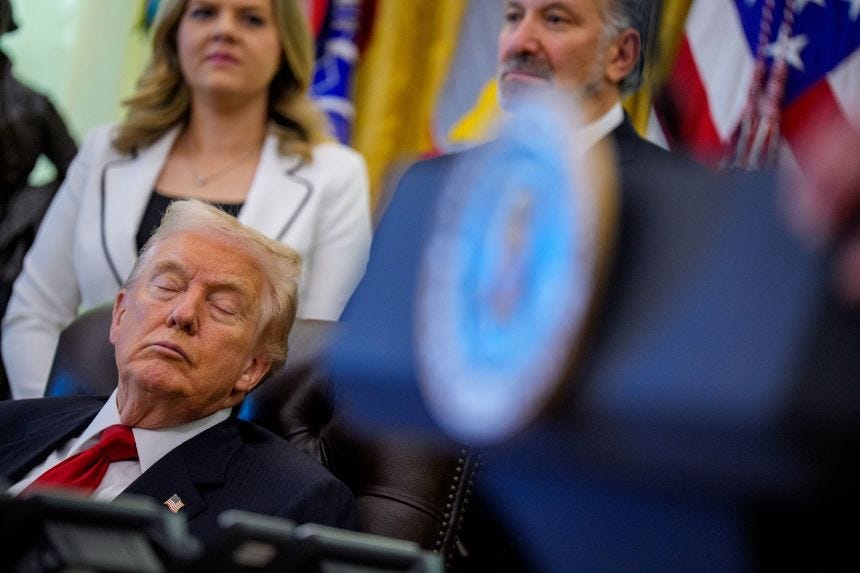
Trump sleeping through today’s Cabinet meeting


Notice the Band-Aid and make-up on his right hand.  Trump is in early stages of Alzheimer’s and he is receiving regular infusions of two drugs called donanemab and lecanemab which are given via intravenous infusion every 1-4 weeks for Alzheimer’s. The treatment requires regular monitoring with brain MRI scans to ensure the medication is not causing bleeds in the brain.


Meanwhile, here’s Pete Hegseth’s name tag.  Look closely.

I guess they meant to say this:

Image

When do we see the MRI results?

Photo two weeks ago at Mar-A-Lago.


This tired, demented, failed, bankrupt deeply-damaged man is so needy. He has to have references to him being president on his hat, on his shirt, and on a faux-gold-framed placard next to his overcooked cheeseburger he’s almost too-out-of-it to eat.