
The U.S. Attorney for the Southern District of Texas, Aaron Reitz, has been busy, but not in the usual way. He’s been sending letters to members of Congress involved in Democratic plans to renew oversight of the executive branch come January. They are “preservation letters,” directing the legislators to preserve documents, etc., “relevant to your intention to weaponize congressional investigations” and referencing criminal statutes Reitz suggests they may be violating.
None of the members of Congress are in his district. Congressman Robert Garcia (California), Senator Richard Blumenthal (Connecticut), Senator Elissa Slotkin (Michigan), and Senator Elizabeth Warren (Massachusetts) have all received letters from Reitz.
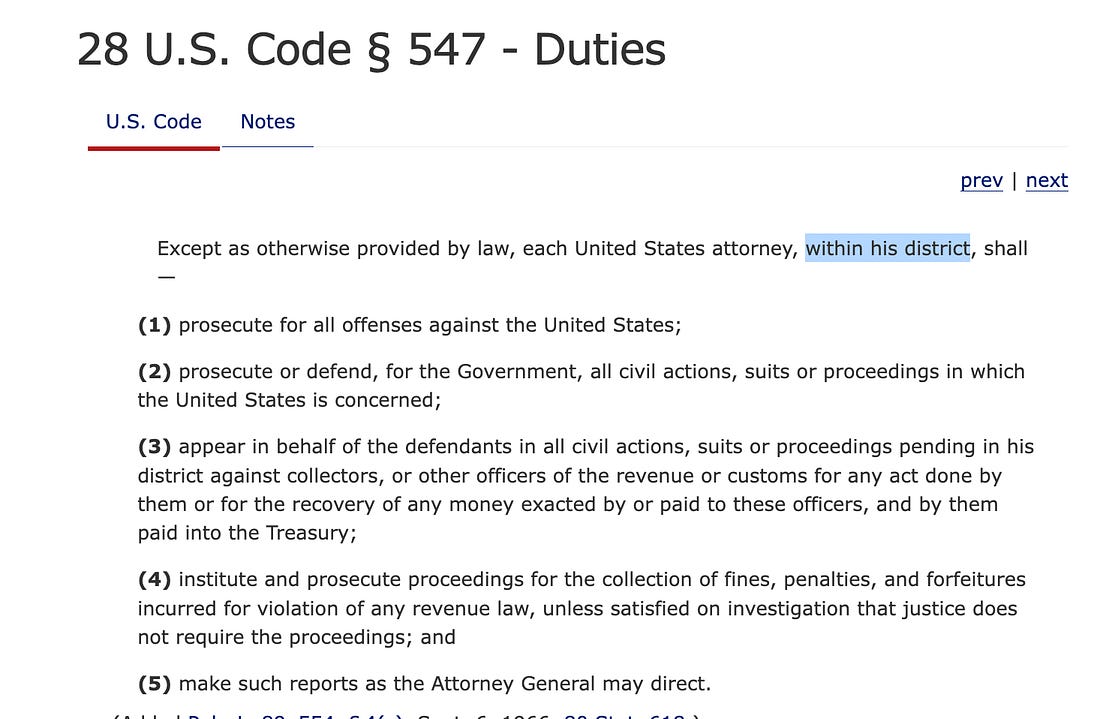
Title 28 U.S.C. § 547 defines the responsibilities of United States Attorneys. They prosecute crimes. They defend the United States when it gets sued and bring affirmative civil lawsuits when appropriate. They collect money judgments on behalf of the United States. But each U.S. Attorney can only do that “within his district” according to the statute. Absent a designation by the Attorney General to take up a matter in another district, for instance, because the U.S. Attorney there must recuse themself, they lack jurisdiction to prosecute crimes committed outside of their district.
 |
The Judiciary Act of 1789 reinforces that point. It created the position of Attorney General and U.S. Attorneys, who were to serve in districts across the country. It requires the appointment, in each district, of a “person learned in the law to act as attorney for the United States in such district, who shall be sworn or affirmed to the faithful execution of his office, whose duty it shall be to prosecute in such district all delinquents for crimes and offences (sic), cognizable under the authority of the United States, and all civil actions in which the United States shall be concerned.” Again, that language appears, not once, but twice: “in such district.”
The notion that U.S. Attorneys lack authority to act outside of their district was recently underscored in Jeffrey Epstein co-conspirator Ghislaine Maxwell’s appeal of her criminal conviction. She argued that she was protected from prosecution in the Southern District of New York by a plea deal Epstein entered into years earlier in the Southern District of Florida. That plea agreement purported to prevent further prosecution of additional defendants. The Court of Appeals for the Second Circuit held that a deal entered into by the U.S. Attorney in the Southern District of Florida didn’t bind U.S. Attorneys in other districts. That’s because, put simply, U.S. Attorneys’ power to investigate and charge is limited to crimes they have jurisdiction over in their district.
In his letters, Reitz invoked two federal crimes: civil rights violations. I’ve worked extensively with those statutes. Even without the First Amendment and Speech or Debate protections that would interfere with the government’s ability to prove its case here, the conduct Reitz is upset about doesn’t amount to a crime. For one thing, the “mens rea,” or state of mind, the prosecution must establish beyond a reasonable doubt is willfulness, which courts interpret as a specific intent to deprive someone of a federally protected right. In a letter sent to Senator Warren, Reitz accuses her, along with Blumenthal and Garcia, of “demanding sweeping information” from a private citizen—which is pretty much how investigations work. There’s no legitimate inference that the legislators are committing crimes; in fact, the suggestion in this context is ludicrous.
Reitz doesn’t appear to have the authority to back up his threatening letters. If the Attorney General had designated him to investigate, that would be an official matter, and it would be public, like when Attorney General Bill Barr designated Connecticut U.S. Attorney John Durham with investigating the origins of the Russia probe following the 2016 election. That hasn’t happened, at least not yet.
Reitz also doesn’t have the resume you’d expect for someone taking on matters like this; Durham, by contrast, was an experienced prosecutor. Reitz served as the head of DOJ’s Office of Legal Policy—as the name suggests, a policy shop, not a litigating division—and as Ted Cruz’s chief of staff. He’s spent some time in private practice, but he doesn’t have the years of expertise in prosecution it takes to handle a complicated matter, which a criminal investigation into four sitting members of Congress engaged in their official duties would certainly be. That lack of experience shows; prosecutors have the ultimate tool for obtaining information from people under investigation, grand jury subpoenas, at hand. There’s no need to resort to preservation letters. The letters feel more like a political ploy than a legitimate prosecutorial strategy. In any other administration, you’d be shocked to see the attorney general designate him to handle matters like this outside of his own district. But here, we’ll just have to wait and see.
Today, The Campaign for Accountability, a public watchdog organization, submitted a grievance against Reitz to the Texas Bar based on his letters to Blumenthal and Warren.
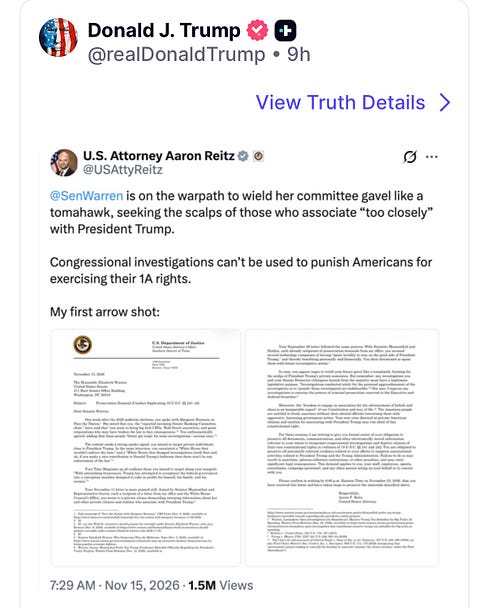
Reitz has caught Trump’s attention, with the president reposting his tweets on Truth Social. Like the one below. “My first arrow shot.” As a former prosecutor, I have questions. “My first arrow shot?” How many is he going to need to get it right? The sprinkling of Native American terms in the letter is beneath the dignity of a sitting U.S. Attorney. In any other administration, it would have resulted in a request for a resignation. Now, it earns the president’s approval.
 |
Reitz’s letters close with a demand for a response from each of the legislators. Their lawyers will likely counsel professional responses; Senator Blumenthal has already sent an appropriately dismissive one. But part of me hopes the four are familiar with the response letter sent by then-Alabama Attorney General Bill Baxley, in response to a letter he received in February 1976 from a grand dragon in the Ku Klux Klan. The letter expressed outrage that Baxley had reopened the investigation into the bombing of the 16th Street Baptist Church in Birmingham that killed four girls getting ready to attend services. The writer demanded a response. Baxley’s letter back was a classic: “Dear ‘Dr.’ Fields,” he wrote, “My response to your letter of February 19, 1976, is — kiss my ass.”